Construction
Where Construction Debris Actually Goes Around Enfield
The Town names demolition material and refuses it outright, then adds a building permit requirement on top. Here is where it actually goes.
The line the Town draws
Enfield's curbside service is clear about where it stops, and the line is drawn harder here than in most towns we work in.
Not "limited to one item". Not "by appointment for a fee". Simply not accepted in the barrel at all.
The Town's bulky collection does not rescue you either. It is appointment only at $150 per truck load, and its own excluded list names asbestos, shingles, sheet rock, concrete, windows with glass, mirrors and paint — which between them cover most of what a renovation produces.
The building permit requirement
The second half of the rule, and the part that catches contractors from outside the area.
So there are exactly two legitimate routes for contractor-generated demolition debris here: the Town, with the permit in hand and arrangements made in advance, or a private hauler. There is no third option where it quietly goes out with the household trash.
In practice most trades take the second route, because a container needs no appointment, no permit to carry and no per-load fee, and it sits on the job for the duration rather than requiring the material to be at the curb on a particular morning.
What the excluded list actually covers
Worth reading against a real job, because the overlap is almost total:
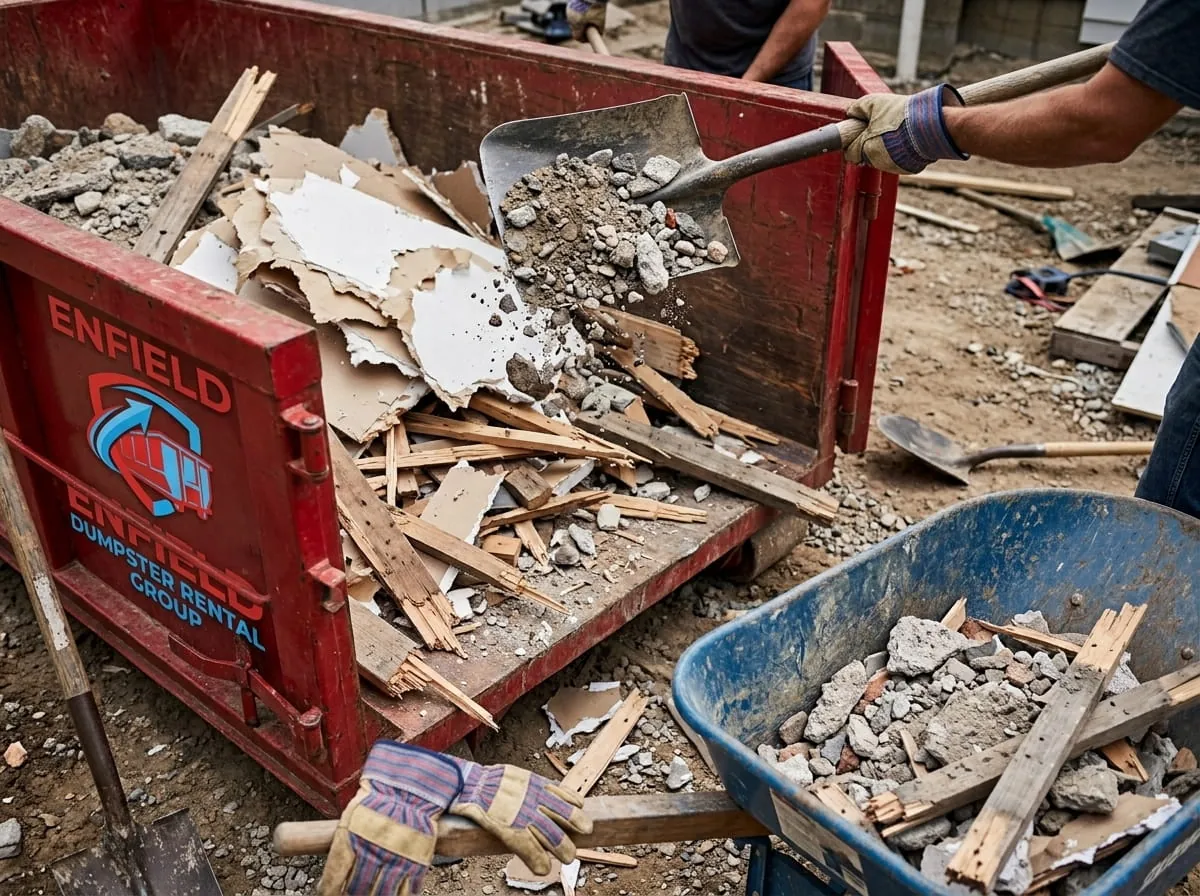
- Sheet rock — every drywall job
- Shingles — every re-roof
- Concrete — every slab, walkway or step removal
- Windows with glass — every window replacement
- Mirrors and tables with glass — most bathroom and furniture clear-outs
- Paint of any kind — the Town points residents to Sherwin Williams or Carr Hardware instead
- Asbestos — licensed abatement only, and never in our containers either
- Car and truck parts, oil and batteries — oil and batteries go back to the auto parts store where they were bought
Everything on that list except the asbestos and the paint is fine in our containers. The exclusion is the Town's, not the material's.
Why stream separation saves money
Disposal is priced per ton and the rate varies by stream. Mixed C&D is the most expensive. Clean inert material is cheaper. Clean vegetation has its own route again. Scrap metal has positive value — and locally, a free one.
Consider a renovation producing six tons of plaster and general debris, four tons of clean concrete and a pile of scrap metal and cardboard. All in one container and you pay the mixed rate on everything. Split it and the concrete moves to a cheaper route, while the metal and cardboard go to the transfer station free, with no permit required.
That last point is worth repeating because it costs nothing: scrap metal, cardboard, televisions, microwaves and electronics are accepted at the transfer station with no fee and no permit.
The five streams worth separating
1. Clean concrete, block, brick and stone
Rebar is generally fine. Timber, plastic sheeting and general debris are not. Goes in a 10 yard because of weight, always.
2. Scrap metal
Copper pipe, steel studs, ductwork, conduit, railings and appliances. Free at the transfer station, no permit needed, so this one is pure saving.
3. Cardboard and packaging
New construction generates an extraordinary amount, and it is also free at the transfer station.
4. Clean vegetation and yard waste
Free of additional fees at the transfer station with a valid permit.
5. Clean dimensional lumber
Untreated, unpainted, fasteners removed where practical. Treated timber does not qualify, which matters because deck and fence timber nearly always is.
Plaster and lath change the maths
Worth its own section because it is the most common sizing error on older-house work here.
Pre-1950 housing across Enfield, Suffield, Windsor, the mill villages and most of Springfield is plaster on wood lath, not drywall. Plaster is dramatically heavier — a room that would be a comfortable half-container of drywall debris can be at its weight allowance in plaster alone.
The genuinely old property adds more: oak and chestnut framing, fieldstone foundations, and in the grander houses slate roofing. All far denser than modern equivalents.
The practical consequence: on an older-house gut, size down and swap more often rather than filling one big container you cannot legally haul.
Asbestos and pre-1980 buildings
This region has a very high proportion of pre-1980 housing, and genuinely old fabric in Windsor, Suffield and the mill villages. Floor tile and its mastic, pipe lagging on old boiler runs, and textured coatings are the usual culprits.
Anything from before roughly 1980 should be treated as asbestos-suspect until surveyed. Abatement is licensed work with its own disposal route and it never goes in a roll-off container — the Town excludes it too. Get the survey done before demolition starts rather than halfway through a strip-out.
Practical site setup
- Place containers where the work is, not where they are convenient for the truck. Labour spent walking debris across a site is the largest hidden cost in waste handling.
- Label them. A sheet of plywood marked CLEAN CONCRETE ONLY protects the cheaper route.
- Brief the trades. One subcontractor throwing a lunch bag into the clean metal pile turns a free load into a billed one.
- Keep clear of overhead lines and mature trees. The truck bed needs roughly twenty-two feet of vertical clearance to tip.
- Book swaps into the programme, not on the day you notice the can is full.
- Cover it in winter. A frozen load will not tip and the container comes back still full.
- Watch the spring thaw. When the frost comes out of the ground, a site route that carried loaded trucks all winter will not carry them in April.
We are happy to help set that up — tell us the build programme and we will schedule around the trade sequence.
Need a container in Enfield?
Call and describe the job. Three minutes on the phone gets you a size recommendation, a flat rate and a delivery window — and we will tell you if a smaller, cheaper container is the right answer.
Call (860) 835-0502